

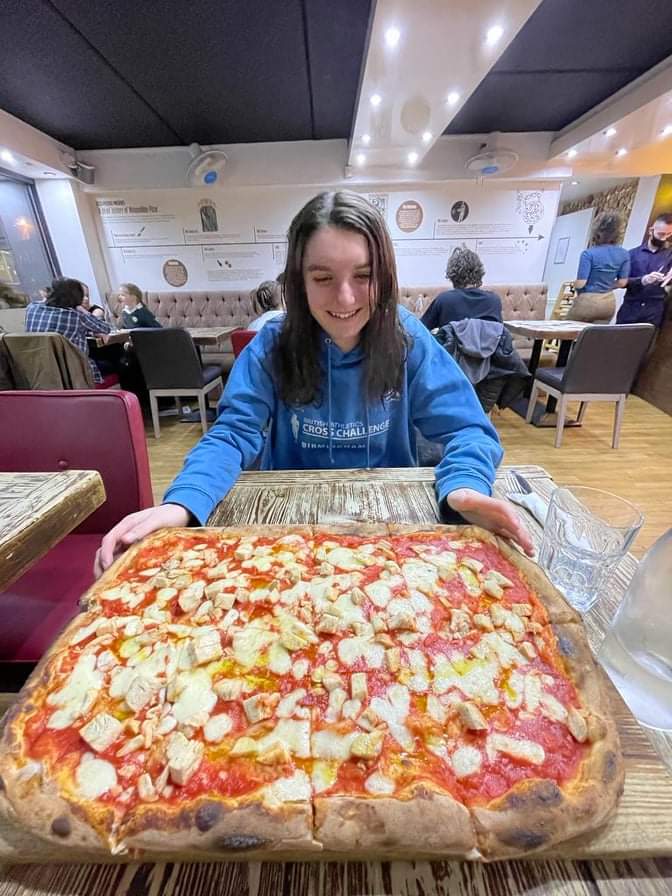
When I was in my final year of University I shared a flat with three other girls. One night after a tough day’s training, I was sat in the kitchen eating a margherita pizza and garlic bread when my friend entered with a concerned look upon her face. My friend, who studied Science of Sport Performance at the rival University (University of Leeds > Leeds Beckett University), and knew my hectic training schedule, said quite sternly ‘where’s your protein’? I naively replied ‘it’s in the cheese’. She then looked like she was going to faint from shock: I had trained around five hours that day, having had a threshold swim in the morning and a long ride in the afternoon, followed by transition practice in the evening. Yet, I had taken on hardly any protein throughout the day and I believed that some cheese on my pizza would be enough to support my body with that high training load! I was immediately thrown some pre-cooked chicken to add on top.
What followed was a long discussion and the revelation that I was always hungry and constantly tired. Protein leaves you feeling fuller for longer as opposed to carbohydrates and fat (the other major macronutrients the body needs) due to the release of hormones from the intestine after consumption, which then act on parts of the brain to control food intake (Journel et al., 2012). It is also essential for muscle recovery and the construction of cells, muscles, bones, hormones and antibodies, which fight infections. Therefore, insufficient protein intake can lead to fatigue and mean you are more susceptible to illness and injury!
She then explained that I must have some source of protein with every meal. But how much did I need to eat? What did I need to eat? And when did I need to eat?
Typically, an endurance athlete such as a triathlete should aim to get around 1.2 – 2.0 grams of protein per kilogram of body weight each day. For instance, if you weighed 70 kg you would need to have between 84 -140 grams of protein each day when you’re in the full swing of training. So for me, I started to eat beans on toast for breakfast after swimming, I would make my usual peanut butter and banana smoothie but with an added raw egg, and I even swapped my favourite snack, ready salted crisps, for a nutty flapjack. After implementing these simple changes I noticed a huge difference in my energy levels. It was amazing! I had never felt so recovered and ready for a hard day’s training.

Later on, I learnt that it is also important to eat protein regularly throughout the day rather than in one go, otherwise your body will just excrete excess amino acids (the building blocks of a protein) or store the protein as fat. Realistically, this means the maximum amount of protein that your body can deal with in one meal is around 30 grams. Additionally, it is particularly important as an athlete to have high protein foods before you go to sleep because this is when your body does most of its muscle repair. Furthermore, refuelling with protein (and carbohydrates) within thirty mins of exercise is again important for recovery.
So, what should you eat? Classic examples include eggs, fish such as cod and salmon, legumes, nuts and chicken. If you wanted to branch out a little you can add Greek yoghurt, lentils, chickpeas, black beans, mackerel, sardines, quinoa, pumpkin seeds and tofu to your diet. Start by making simple switches or subtle changes so not to get overwhelmed. For example add chicken to a margherita pizza or fry an egg to stick on top. This way your slowly build up your protein intake, which will hopefully help you recover better and quicker for your next training session.
Reference:
Journel, M., Chaumontet, C., Darcel, N., Fromentin, G. and Tomé, D. 2012. Brain response to high-protein diets. Advances in Nutrition. 3 (3), pp, 322-329.
 Fiona German Coaching